






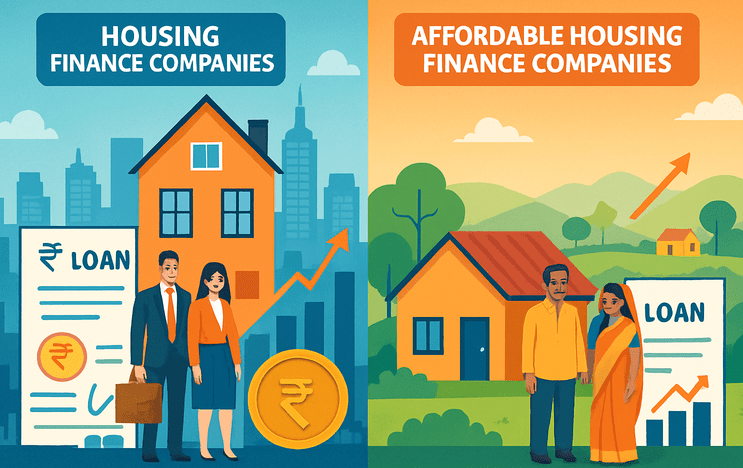
India’s housing finance ecosystem comprises two distinct segments—regular Housing Finance Companies (HFCs) and Affordable Housing Finance Companies (AHFCs). While both extend long-term loans for home purchases, they differ fundamentally in target customer, ticket size, regulatory treatment, risk profile, and market dynamics. Below is a detailed comparison, followed by sector growth trends and key financial metrics for leading AHFCs.
Contents
Key Differences Between the Two CategoriesAffordable Housing Finance Companies (6 Listed)Regular Housing Finance Companies (13 Listed)Market Statistics SummaryGrowth TrendsHousing Finance Companies: Growth PotentialCAGR Outlook:Drivers:Affordable Housing Finance Companies: Growth PotentialAUM Growth:Key Comments (ICRA, NHB):Key Takeaway
Key Differences Between the Two Categories
| Parameter | Housing Finance Companies | Affordable Housing Finance Companies |
| Target Customers | All income segments | Economically Weaker Sections (EWS), Low-Income Groups (LIG), Lower-Middle Class |
| Average Ticket Size | ₹25 lakh+ | ₹7 – 12 lakh |
| Property Value Limits | No specific caps | ≤ ₹45 lakh (metros), ≤ ₹30 lakh (non-metros) |
| Interest Rates | ~7 – 9% | ~8 – 12% |
| Geographic Focus | Tier-1 (metros) | Tier-2/3 & rural |
| Customer Profile | Salaried, formal income | Self-employed, informal income |
| Risk Profile | Lower | Higher |
| Regulatory Treatment | General HFC norms | Priority Sector Lending status* |
Affordable Housing Finance Companies (6 Listed)
| Company | Market Cap (₹Cr) | Current Price (₹) |
| Aadhar Housing Finance | 21,560 | 499 |
| Aptus Value Housing | 16,918 | 338 |
| Aavas Financiers | 13,302 | 1,680 |
| Home First Finance | 12,384 | 1,199 |
| India Shelter Finance | 9,784 | 906 |
| SRG Housing | 510 | 325 |
Regular Housing Finance Companies (13 Listed)
| Company | Market Cap (₹Cr) | Current Price (₹) |
| Bajaj Housing Finance | 94,155 | 113 |
| LIC Housing Finance | 31,343 | 570 |
| PNB Housing Finance | 21,119 | 812 |
| HUDCO | 21,000 | 212 |
| Sammaan Capital | 10,288 | 125 |
| Can Fin Homes | 9,845 | 740 |
| Repco Home Finance | 2,508 | 401 |
| GIC Housing Finance | 1,015 | 188 |
| Reliance Home Finance | 250 | 5 |
| Star Housing Finance | 198 | 25 |
| India Home Loans | 50 | 35 |
| Ind Bank Housing | 41 | 41 |
| Sahara Housing | 28 | 40 |
Market Statistics Summary
- Total Listed Housing Finance Companies: 19
- Affordable Housing Finance Companies: 6 (32% of total)
- Regular Housing Finance Companies: 13 (68% of total)
Growth Trends
| Lending Segment | FY25–28 CAGR | AUM Target (FY28) | Source |
| Housing Finance Companies (HFCs) | 15–19% | ₹20 trillion | ICRA, NHB |
| Affordable Housing Fin. Cos. (AHFCs) | 20–22% | ₹2.5 trillion | ICRA |
Housing Finance Companies: Growth Potential
CAGR Outlook:
- According to CareEdge Ratings and National Housing Bank (NHB), the Indian housing finance market—including HFCs and banks—is projected to grow at a 15–16% CAGR between FY25 and FY30.
- Industry AUM stood at approximately ₹33 trillion as of March 2024, with housing loans accounting for 14% of total systemic credit.
- ICRA estimates overall mortgage loans by NBFCs/HFCs to reach ₹20 trillion by FY2028, up from ₹13 trillion in March 2025, implying a 17–19% CAGR for HFCs over the next three years.
Drivers:
- Structural tailwinds: improved affordability, rising urbanization, nuclear families, “Housing for All” and PMAY schemes.
- Asset quality has stabilized, with most HFCs operating at low NPA levels.
- Government budget allocations and incentives are providing significant thrust.
Affordable Housing Finance Companies: Growth Potential
AUM Growth:
- ICRA projects that AHFCs will see AUM rise from ₹1.4 trillion (Mar 2025) to ₹2.5 trillion by FY28, representing a CAGR of 20–22%—well above the broader HFC sector’s growth.
- AHFCs make up about 11% of total AUM for all mortgage lenders, but their growth is “steep” due to strong demand for smaller ticket loans and underserved borrower base.
Key Comments (ICRA, NHB):
- Demand for home loans among EWS/LIG segments, lack of alternative credit, and PSL benefits ensure faster AUM growth for AHFCs.
- AHFCs face higher operational intensity (more branches/staff needed) but enjoy higher portfolio yields and strong risk-adjusted returns.
- NHB projects ongoing robust trends due to urban migration, budgetary incentives, and macro tailwinds.
Key Takeaway
- Both HFCs and AHFCs have strong long-term growth potential, with AHFCs projected to grow the fastest.
- This outperformance for AHFCs is driven by the surge in affordable housing demand, government push via policies and subsidies, and the relatively lower credit penetration among EWS/LIG groups.
- Government/rating agency consensus is: The next phase of India’s retail credit growth will be mortgage/affordable housing led, and the total mortgage opportunity could approach USD 1.5 trillion by FY35 as mortgage penetration rises toward levels seen in China and major economies.
All figures and forecasts above are strictly from government and rating agency sources (ICRA, NHB, CareEdge, RBI)