Why FIIs Are Selling India and What Will Bring Them Back
The question every investor is asking
FIIs have been net sellers of Indian equities for almost two years. Many retail investors read this as a verdict on India. The data says otherwise. The selling has little to do with India and almost everything to do with three Asian chip companies and the global AI boom.
The “benchmark trap”
Most foreign money in India comes from global emerging-market (EM) funds. These funds are judged against the MSCI EM index, the way a student is graded against the class average. If a stock’s weight in the index jumps and a fund doesn’t own it, the fund falls behind.
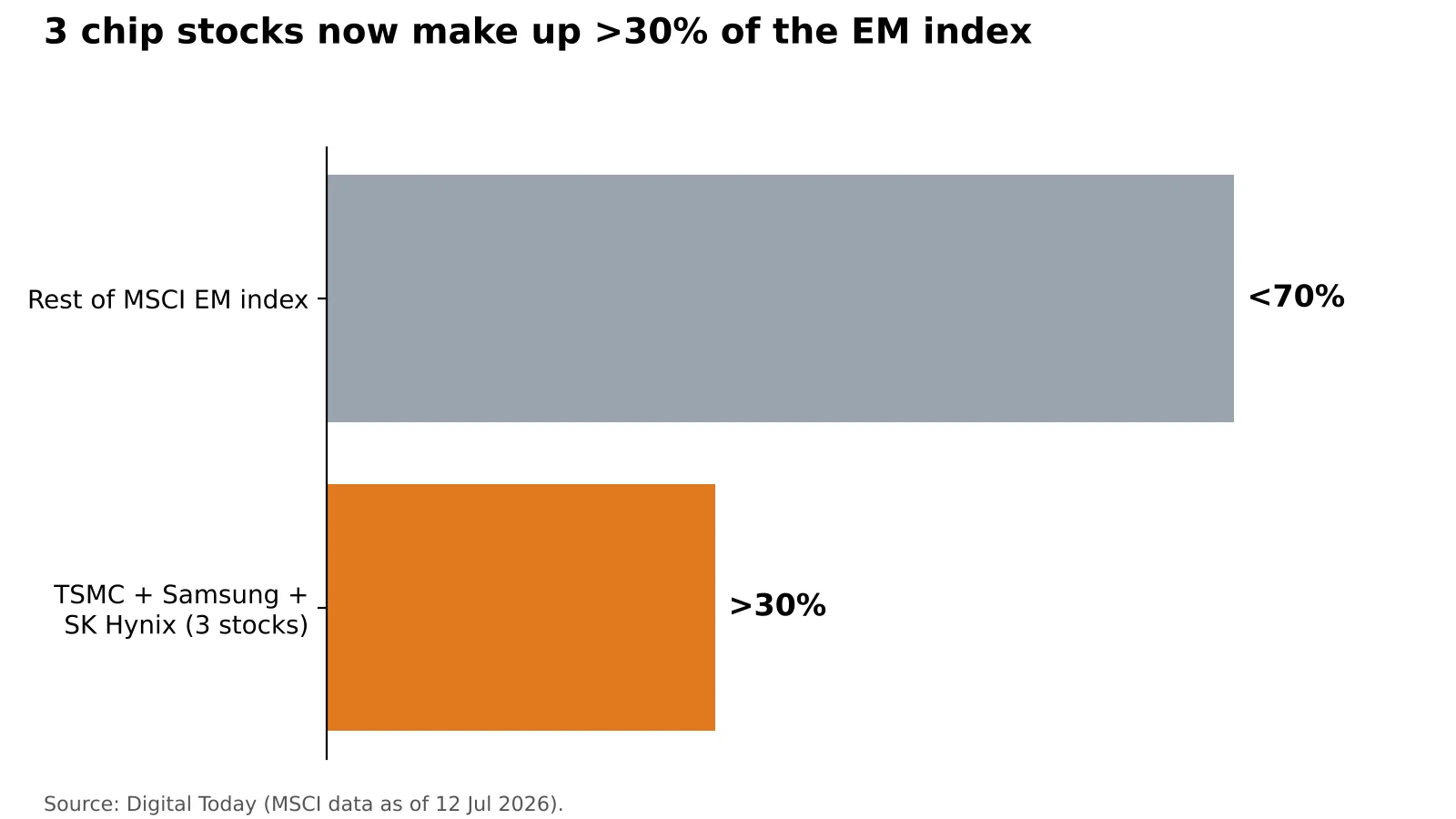
That is exactly what happened. As of July 2026, three stocks, TSMC, Samsung Electronics and SK Hynix, make up more than 30% of the MSCI EM index.
Country weights tell the same story. India’s weight in the index has fallen from nearly 21% in September 2024 to about 12% in May 2026. Over the same period, South Korea’s weight jumped from 9% to 19% and Taiwan’s from 17% to 25%.
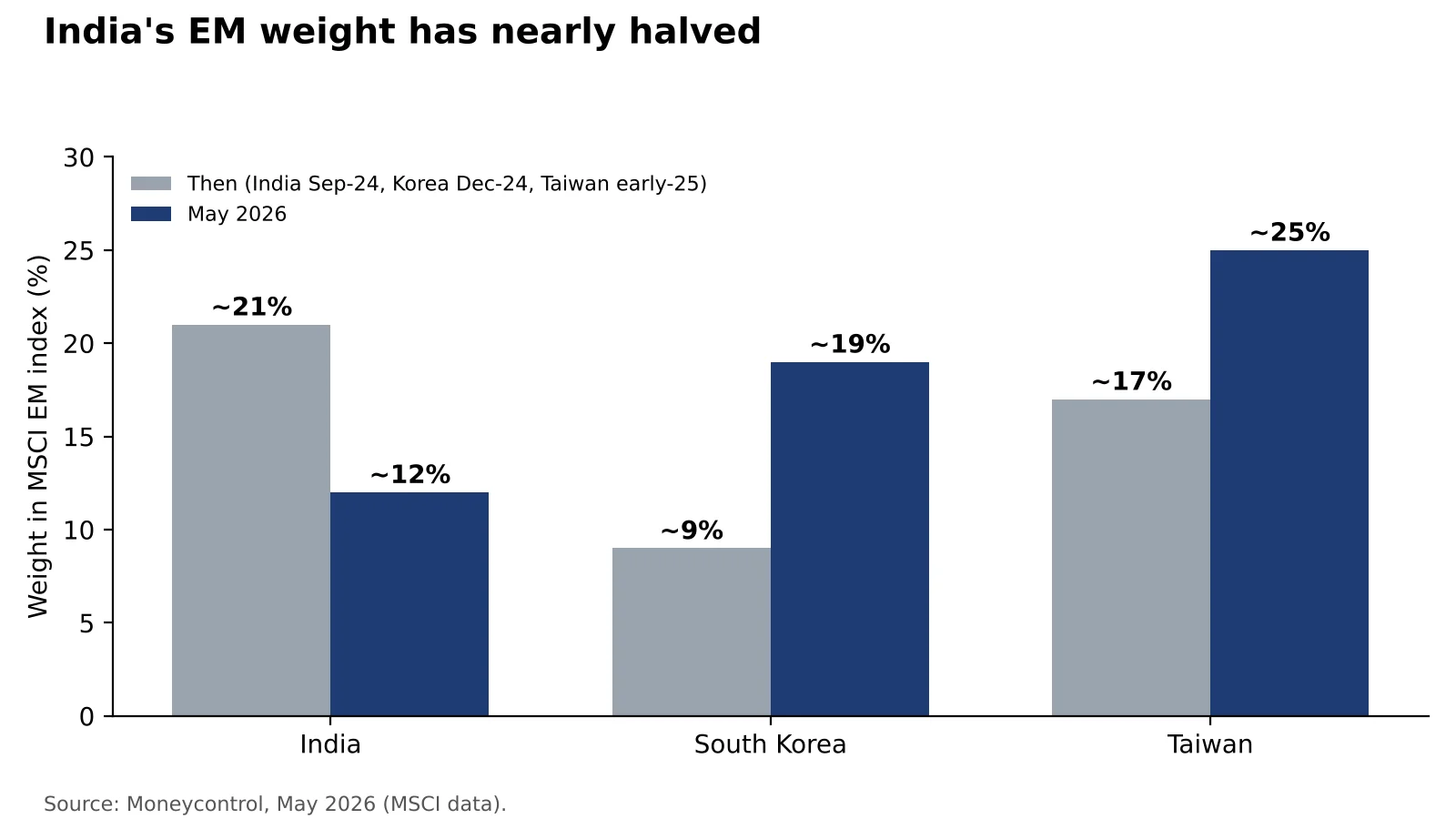
EM funds were overweight India for years. When Korea and Taiwan suddenly became much bigger in the benchmark, the funds had to buy them, and that money came out of India, the market they owned most.
The earnings behind the shift
This is not just hype. AI data centres need huge amounts of memory chips, and Samsung and SK Hynix dominate that market. Each company is projected to earn close to $68 billion in 2026. Their combined Q3 2026 operating profit is forecast at nearly ₩190 trillion.
Think of it this way. If one shop on the street suddenly earns more than the whole street combined, every investor rushes to that shop, even if the other businesses are doing fine.
India is the “inverse AI trade”
This is where it gets interesting for Indian investors. India has little direct AI exposure. That hurt while the AI trade was hot, but it could help when the trade cools. If the AI story falters, money that left India to chase chip stocks has a natural place to return to.
Are there warning signs? The big US tech companies (Amazon, Alphabet, Meta and Oracle) are no longer funding AI spending only from their own cash. They are borrowing heavily.
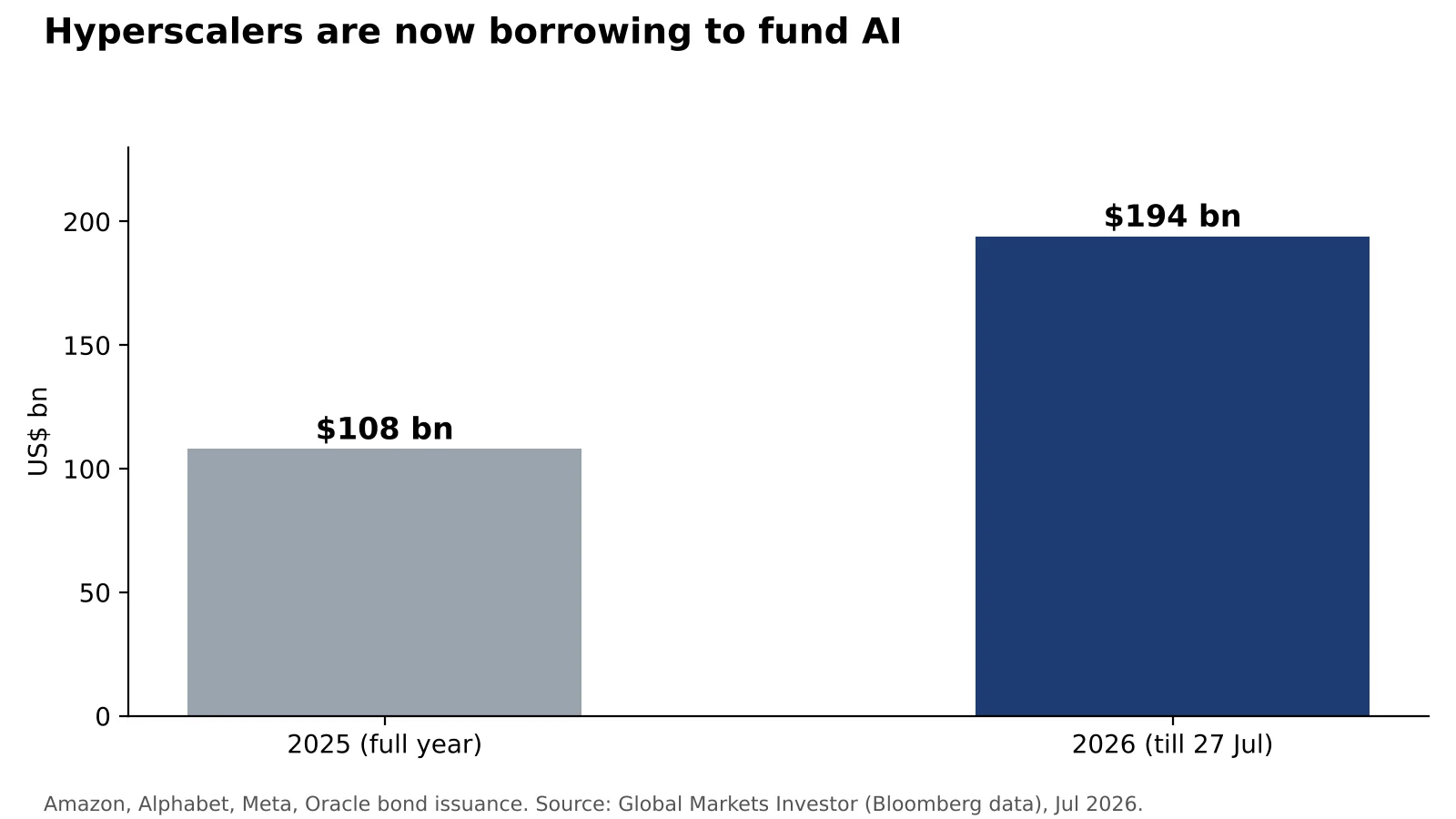
Their bond issuance in the first seven months of 2026 is already almost double the full-year 2025 figure. More borrowing means more risk if the returns on AI spending take longer to arrive. Nobody knows when, or whether, the market will lose patience.
Why the Nifty feels stuck
There is also a domestic reason the index has gone sideways. SIP inflows are at record levels, but they are being absorbed by new share supply: IPOs, QIPs, block deals and promoter stake sales. Every time the market rises, more supply arrives.
That does not make India a bad market. It makes it a bottom-up market, where returns come from picking the right companies rather than owning the index.
What retail investors should track
- Big Tech results every quarter. If these companies raise AI capex guidance and their stocks fall, the market is losing patience.
- Korean memory chip prices and stocks. A peak there would likely mark the turn in EM fund flows.
- India’s MSCI EM weight. A stabilising or rising weight would signal that the rebalancing is over.
- The rupee. A stable rupee makes Indian assets more attractive to foreigners.
- Monthly SIP flows. As long as they hold, domestic money cushions the market against FII selling.
The cautionary side
The “inverse AI” idea has risks. If the AI bubble bursts into a US recession, global markets will fall together at first, and India will not be immune. Indian mid and small caps are also expensive, which makes them vulnerable if the Middle East conflict escalates. And if Big Tech does earn strong returns on its AI spending, money may stay in Korea and Taiwan for longer.
Bottom line
FII selling reflects global benchmark rebalancing, not a breakdown in India’s fundamentals. The long-term story is intact, and if the AI trade turns, India stands to benefit. For now, the opportunity is in picking stocks, not in the index.